


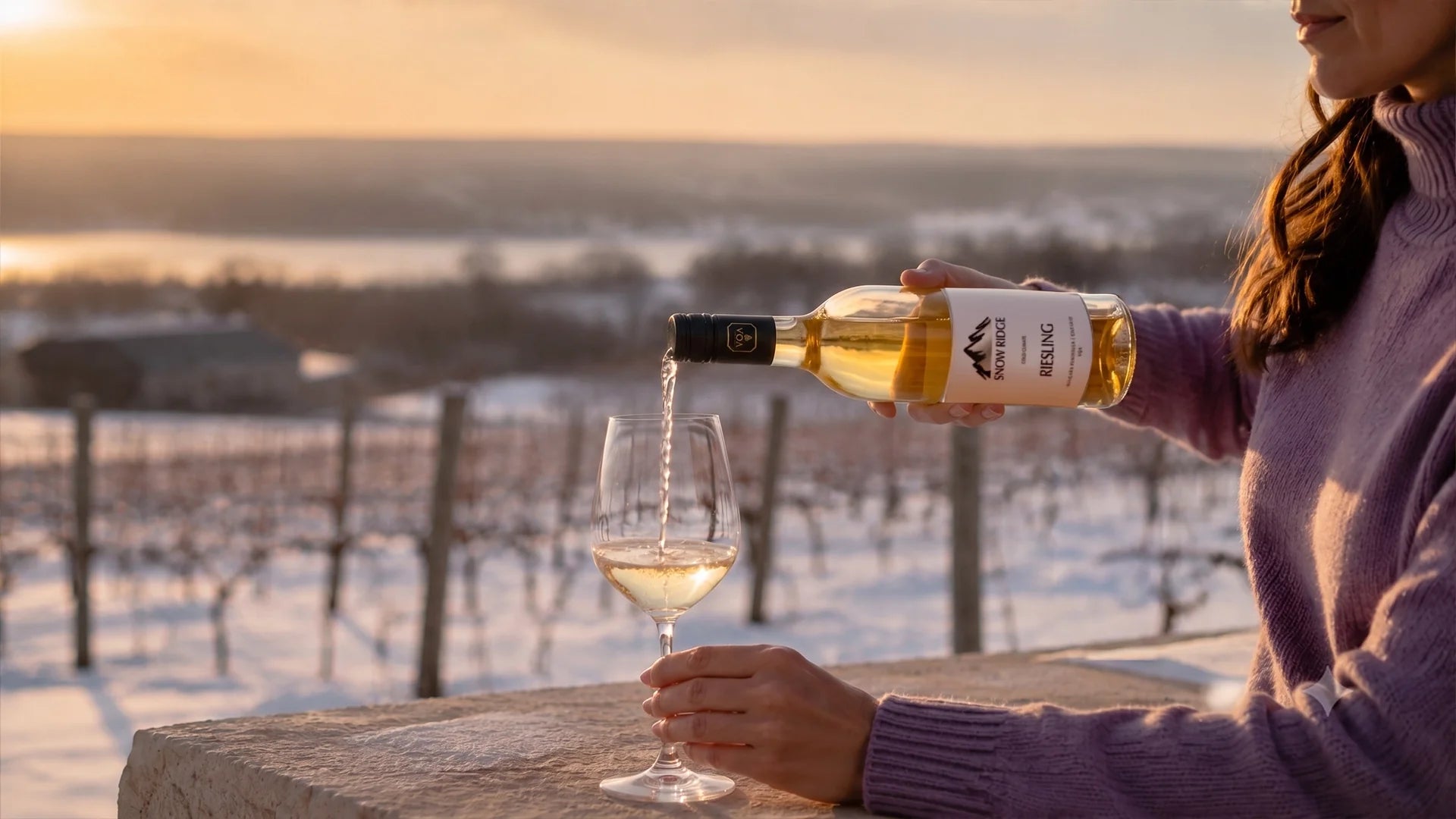
Picture a vineyard in Ontario on a December night. It's ten below zero Celsius — about 14°F — headlamps are bobbing between the rows, and picking crews in ski gloves are snapping frozen clusters off the vine like stones.

They have to. The law says these grapes must come off frozen solid, at minus 8°C (about 18°F) or colder, usually in the small hours before dawn.
Each rock-hard berry gives up a single drop of nectar when pressed. That drop is icewine, and Canada makes it better and more reliably than anywhere on earth.
It's also only the first chapter. The part most drinkers never get to is a wine country that has quietly gotten serious.
How Icewine Actually Works
The rules are brutal on purpose. Under Canada's VQA law, icewine grapes must freeze naturally on the vine at minus 8°C or colder and be pressed while still frozen. No freezers, no shortcuts.
The water in each berry locks up as ice crystals, so the press squeezes out only the concentrated essence — sugar, acid and aromatics at syrup density, often at a tenth of a normal harvest's yield.
The grapes hang exposed for weeks or months past ripeness waiting for that freeze, gambling an entire crop against birds, rot and warm spells. When it works, you get intense sweetness — apricot, lychee, honey, tropical fruit — carried by an acidity so bright it never turns cloying. Good icewine finishes clean, not sticky. That's the whole test.

Now the part that explains why Canada owns this category.
In Germany, birthplace of Eiswein, a proper freeze arrives maybe two or three vintages a decade. It's a lottery ticket. In Ontario, deep-winter cold is a scheduled event. Canada took a climatic liability and turned it into the most dependable supply of a rare wine style in the world.
The moment it became official was 1991, when Inniskillin's 1989 Vidal icewine won the Grand Prix d'Honneur at Vinexpo in Bordeaux. That's Canadian wine's Judgment of Paris — the day the old world blinked.
Grape choice sets the style. Vidal, a thick-skinned hybrid built to survive the hang, gives tropical opulence: mango, apricot, honey. Riesling icewine is the connoisseur's cut — leaner, citrus and mineral, knifelike acidity, and the one I'd put in a cellar. And Cabernet Franc icewine, a Canadian specialty, presses frozen red grapes into a rhubarb-and-strawberry rarity almost nobody else attempts.
Niagara: The Lake Effect
Ontario's vineyards survive Canadian winters because of one of the great climate machines in wine: Lake Ontario.
The lake soaks up summer heat and releases it through autumn, stretching the growing season. In spring it stays cold and delays budbreak until the frost window has passed.
Meanwhile the Niagara Escarpment — the same limestone ridge the falls pour over — deflects that lake air into a slow circulation that stops hard freezes settling into the vines.
Inside that protected band, sub-zones like the Beamsville Bench are turning out taut Chardonnay, fragrant Pinot Noir and dry Riesling with real cut. The region hosts an international cool-climate Chardonnay celebration that draws Burgundians, and they leave impressed.
Icewine built Niagara's name. The table wines are what will keep it.
British Columbia: Desert in the North
Four provinces west, the Okanagan Valley runs a hundred miles through the rain shadow of the Coast Mountains, ending near Osoyoos in what's often called Canada's only desert.
Summer days there are hot and bone-dry, and at the 49th parallel the daylight stretches past anything California gets. A chain of deep glacial lakes — Okanagan Lake drops hundreds of feet — moderates both summer nights and winter lows.
The south valley ripens Syrah, Merlot and Cabernet Franc with dark, sun-soaked conviction. The north does aromatic whites and Pinot Noir. Mission Hill and Tantalus headline a scene Canadians largely drink before any of it reaches an export container, which tells you how good it's gotten.
The East Coast Wildcard
Ontario's Prince Edward County grows Chardonnay and Pinot Noir on limestone — and buries its vines under mounded earth every winter to keep them alive, digging them out again by hand each spring. That's the level of commitment the climate demands.
Nova Scotia, of all places, is producing traditional-method sparkling wine of startling quality. Benjamin Bridge's bubbles run on the same cool-climate math as Champagne. Alongside it sits Tidal Bay, a crisp signature white appellation built specifically for the local seafood.
Canadian wine keeps happening in places the textbooks said it couldn't.
Drinking Icewine Like You Know What You're Doing
Icewine comes in half-bottles and 187ml splits for a reason. Two ounces per person is a full experience, not a small one.
Serve it properly cold, around 45°F, in a small white-wine glass.
The one pairing rule that matters: keep the food less sweet than the wine. Blue cheese is the classic collision — salt against nectar. Foie gras, fruit tarts and aged cheddar all work. Or pour it on its own as dessert, which is how most of Niagara actually drinks it.
And put a bottle away. With that acid spine, good icewine ages a decade and more, deepening into caramel, dried apricot and marmalade.

Quick Answers: Canada Wine
How is icewine actually made?
Grapes are left hanging into winter and must freeze naturally on the vine at minus 8°C (about 18°F) or colder, then be pressed while still frozen, usually at night. The water stays behind as ice crystals, so each berry yields a single drop of concentrated nectar.
Why is Canada the world's icewine leader?
Consistency. Germany's Eiswein depends on a freeze that arrives maybe two or three vintages a decade. In Ontario's Niagara Peninsula a proper deep freeze is close to an annual certainty, which lets Canada produce icewine reliably at a scale and quality no one else matches.
What does icewine taste like and how do you serve it?
Apricot, lychee, honey and tropical fruit, carried by acidity bright enough to keep it from ever tasting cloying. Serve it around 45°F in small pours — two ounces per person — with blue cheese, foie gras or fruit desserts, or on its own as dessert.
What is the difference between Vidal and Riesling icewine?
Vidal is a thick-skinned hybrid bred to survive months hanging in the cold, and it gives the opulent tropical style: mango, apricot, honey. Riesling icewine is leaner and more citrus-and-mineral, with sharper acidity, and it typically ages longer.
Does Canada make good table wine too?
Yes. Niagara produces increasingly serious Chardonnay, Pinot Noir and dry Riesling, while British Columbia's Okanagan Valley grows bold Syrah and Merlot in the country's driest corner. Most bottles sell out domestically, which is why the icewine gets the export fame.
Ready to explore? Our Canada collection carries our current selection. And if you're hunting a specific bottle from the region, contact us for a quote — we source wine globally, with a 12-bottle minimum on special orders.

















Shop Our Canada Collection
SHOP COLLECTIONShare:
American Wine: The Grand Tour, Coast to Coast
American Wine: The Grand Tour, Coast to Coast
Comments Section