

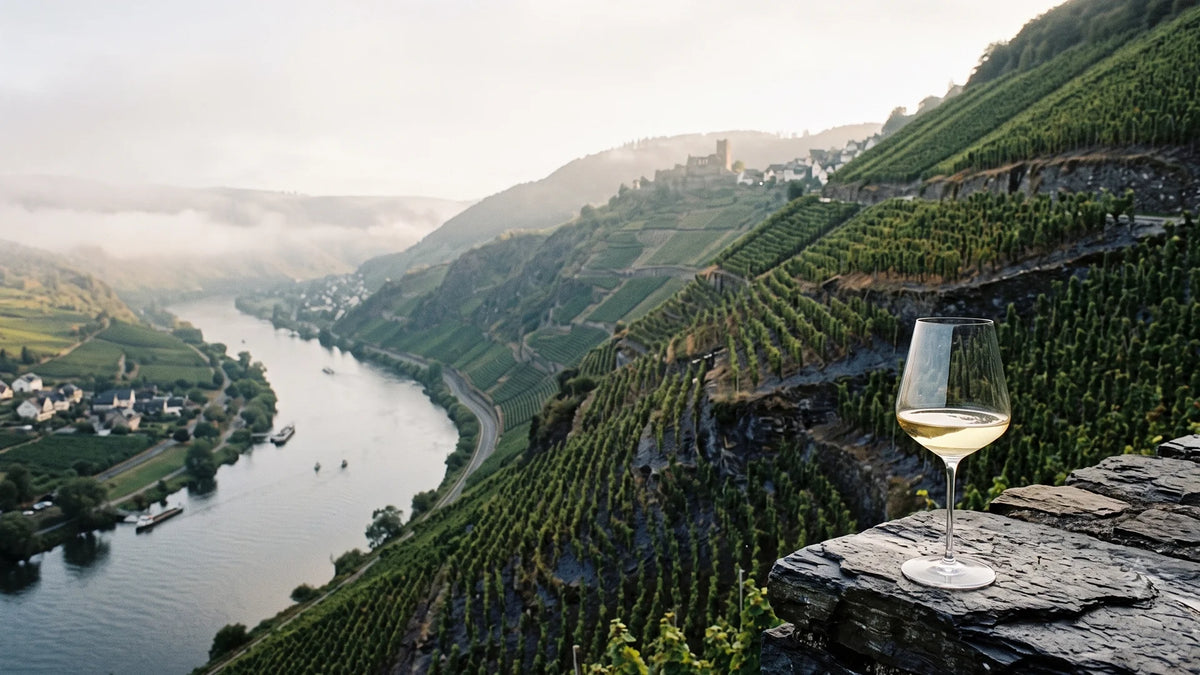
The steepest vineyard in Europe isn't on a mountain. It's on a riverbank in Germany: the Calmont, on a hairpin bend of the Mosel, where the slope hits 65 degrees, and pickers clip into ropes and rail-sleds to bring in Riesling that grows closer to vertical than horizontal.
Germany farms wine at the cold northern edge of what the vine can survive, on latitudes level with Newfoundland, and it works for one reason: rivers. The Mosel, Rhine, Nahe, and Main carve south-facing amphitheaters that catch every degree of sun, while black slate soaks up heat all day and radiates it back all night like a storage heater.
Out of that ingenious desperation comes the world's most misunderstood great wine, and for anyone willing to learn a few label words, its most underpriced.

The Riesling Truth
Say "German wine" and most Americans still hear "sweet." Here's the reality. Riesling is one of the most transparent, site-expressive white grapes in the world, and most of what Germany actually drinks today is bone dry.
The sweet reputation came from a flood of cheap sugar-water exports in the 1970s (Liebfraumilch has a lot to answer for). That buried the truth: German Riesling runs the entire register, from steel-dry to off-dry to nobly sweet to sparkling.
What ties them together is the electricity, screaming acidity balanced against fruit and stone, plus low alcohol, often 8 to 12 percent, and a capacity to age that few wines can match. Well-kept Rieslings from the 1950s, even the 1920s, still drink with color and nerve. Few white wines age longer, and fewer age as well.

How to Read a German Label in Ninety Seconds
German labels look like tax documents, but the code is short. The traditional Prädikat ladder measures ripeness at harvest, not sweetness in the glass. Kabinett is the lightest, picked first. Spätlese means "late picked," so riper and fuller. Auslese is made from selected extra-ripe bunches. Then come the nobly rotten and frozen rarities, Beerenauslese, Eiswein, and Trockenbeerenauslese, which rank among the most prized sweet wines in the world.
One thing to hold onto: a Kabinett or Spätlese can be made dry. The word trocken means dry, full stop. Feinherb or halbtrocken means gently off-dry.
And the modern grand-cru system cuts through all of it: GG (Grosses Gewächs) on a bottle means a dry wine from an officially classified great vineyard, Germany's answer to grand cru Burgundy, usually at a fraction of the Burgundy price.
Learn two words, trocken and Kabinett, and one abbreviation, GG, and you can shop German wine like an insider.
The Mosel: Slate, Filigree, and Rope-Team Farming
The Mosel and its tributaries, the Saar and Ruwer, are Riesling's most extreme theater: blue and grey Devonian slate, slopes that make ski runs look tame, and wines of impossible delicacy, white flowers, green apple, wet stone, at eight or nine percent alcohol.
The great sites read like scripture: the Bernkasteler Doctor, the sundial vineyards of Wehlen and Zeltingen, the Scharzhofberg of the Saar, where Egon Müller's Trockenbeerenauslese sells for more per bottle than first-growth Bordeaux, one of the most expensive white wines in the world, from a country the market still treats as a bargain. J.J. Prüm, Fritz Haag, and Dr. Loosen carry the classic style. A Mosel Kabinett with a decade on it, still crackling with acidity at ten percent alcohol, is one of wine's quiet miracles.
The Rhine Family: Rheingau, Rheinhessen, Nahe, Pfalz
The Rheingau is Riesling's aristocratic seat, a single sunny bank where the Rhine briefly runs east-west, farmed by monasteries and princes for a millennium.
Schloss Johannisberg claims the founding legend of late harvest itself: in 1775, the courier carrying the official picking order arrived two weeks late, the "spoiled" botrytized grapes were pressed anyway, and Spatlese was born.
Rheinhessen, once the engine of cheap exports, is now Germany's most exciting region - its rolling limestone country produced the young-gun revolution led by Klaus Peter Keller (whose G-Max Riesling is a global cult) and Wittmann. The little Nahe splits the stylistic difference - Donnhoff's wines are many collectors' definition of perfect balance - while the warm, dry Pfalz, an extension of Alsace, delivers generous dry Rieslings and Germany's best-value everyday whites.

The Red Surprise: Spatburgunder
Quietly, Germany has become the world's third-largest grower of Pinot Noir, Spätburgunder, and a warming climate has turned a former curiosity into a serious rival. The style sits between Burgundy's earth and Oregon's fruit: red cherry, forest floor, fine-boned tannin.
The Ahr, a tiny slate canyon improbably devoted to red wine, and Baden's volcanic Kaiserstuhl are the strongholds. Meyer-Näkel and the late Bernhard Huber made the wines that forced Burgundy lovers to pay attention, at prices village Burgundy abandoned years ago. Franken, meanwhile, keeps its own counsel with dry Silvaner in the squat bocksbeutel flask, the sommelier's German secret. And Germans drink more sparkling wine per person than almost anyone, with a new wave of serious traditional-method Sekt finally worthy of the thirst.
Eiswein and the Sweet Summit
Germany invented the frozen-grape gamble - waiting into December for a hard freeze to concentrate the last hanging fruit - but a real Eiswein year now comes maybe twice a decade in a warming Mosel, which makes German examples rarities priced accordingly (our Canadian icewine guide tells the story of the country that industrialized the freeze).
The broader sweet summit - Auslese to Trockenbeerenauslese - remains Germany's crown: wines of honey, apricot, and saffron held weightless by acidity, capable of outliving every person at the table. Serve them alone, cold, in small glasses, and understand why collectors whisper about them.
Buying Germany Smart
Start dry. A GG from Keller, Dönnhoff, or a top Rheingau estate delivers grand-cru white Burgundy intensity, often $50 to $90 instead of $200 and up. For the table, Kabinett is the secret weapon of the whole wine list: nine percent alcohol, electric, faintly sweet, and one of the best partners anywhere for spicy food, from Thai to Sichuan to barbecue. Feinherb and Spätlese styles reward curry nights and aging alike. Spätburgunder is your Burgundy hedge. And one half-bottle of Auslese in the fridge door will end more dinners memorably than anything else at its price.
The Germans kept the best bottles home for centuries. The labels kept everyone else out. Now you can read them.
Quick Answers: German Wine
Are German Rieslings sweet or dry?
Both, and the label tells you. Trocken means fully dry, feinherb gently off-dry, and a classic Kabinett or Spätlese without those words carries balanced sweetness offset by electric acidity. Germany's dry Grosses Gewächs wines rival white Burgundy.
What do Kabinett, Spatlese and Auslese actually mean?
They rank the ripeness of the grapes at harvest, not the sweetness of the wine: Kabinett is picked earliest and lightest, Spatlese late-picked and deeper, Auslese from selected extra-ripe bunches - with Beerenauslese, Eiswein and Trockenbeerenauslese as the rare nectar tiers.
Why is Mosel Riesling so light in alcohol?
The Mosel sits near wine's cold northern limit, so grapes ripen slowly on steep slate slopes and are picked with less sugar - yielding wines of seven to eleven percent alcohol that still carry full flavor, plus acidity that lets them age for decades.
Is German red wine any good?
Spatburgunder - German Pinot Noir - has become world-class, especially from Baden and the Ahr; Germany is now the third-largest Pinot Noir grower on earth, and top bottlings embarrass far pricier Burgundies in blind tastings.
Ready to explore? Our Germany collection carries our current selection. And if you are hunting a specific bottle from the region, contact us for a quote - we source wine globally, with a 12-bottle minimum on special orders.


Shop Our Germany Collection
SHOP COLLECTIONShare:
Piemonte Wine: Fog, Nebbiolo, and Italy's Quietest Grand Cru Country
California Wine: The Fog Line, the Fault Lines, and the Golden State's Real Map
Comments Section