

Quick answer: what is the best Chardonnay to buy right now?
There is no single best Chardonnay, because the grape itself is nearly neutral. What you are really choosing between is two things: how much oak the winemaker used, and how cold the site was. Warm sites and new barrels give you the rich, golden style with vanilla, toast and a creamy weight. Cold sites and older wood give you citrus, green apple, wet stone and a lean, mouthwatering line. Neither is better; they are answers to different evenings and different dinners. Every wine on this page was chosen the same way: rated 90 points or better by an independent critic, in stock and ready to ship the day you read this, one wine per estate, and laid out so you can find your own place on that spectrum rather than ours.
Chardonnay is the most planted fine-wine grape on earth and the most misunderstood. Because it carries so little flavor of its own, it does what the place and the cellar tell it to, which is why the same grape can taste like a squeeze of lemon on a rock in one glass and like baked apple and butter in the next. That neutrality is also why it got a bad reputation: a wave of cheap, heavily oaked bottlings in the 1990s taught a lot of people that they hated a grape they had never really met. If that was your experience, the cooler, leaner end of this list is where to start.
How to read this list. It runs in one direction: richest and most oak-framed at the top, leanest and most mineral at the bottom, with the balanced middle in between. Find the part of that range you already like and start there, because the price ladder runs the whole way down it and there is something worth drinking at every rung. Each entry carries the critic's score, because a number from James Suckling, Vinous, the Wine Advocate or Wine Spectator is worth more than our opinion, and each one says plainly where it sits on the oak-and-temperature question. Two shortcuts sit at the top of the list: the bottles the critics scored highest, and the ones our customers keep coming back for. If you want the wider view, the full Chardonnay range and the guides at the bottom of this page are the longer read.

One more thing before you scroll: this page keeps itself honest. Good Chardonnay at a fair price moves, and a guide recommending a bottle nobody can buy is just an advertisement for disappointment. When a wine here sells through it comes off the list automatically and the next one we would genuinely recommend from the same corner of the world takes its place. Every price and every bottle below is live: this is what is in the cellar today, not a snapshot from whenever this page was written.
The Best Chardonnays to Buy Right Now, From Rich and Oaked to Bone-Dry
What the experts are drinking now: 2023 HDV Hyde de Villaine Hyde Vineyard Chardonnay Carneros (99 James Suckling); 2023 Pahlmeyer Napa Valley Chardonnay (97 James Suckling); 2024 Marchesi Antinori Castello della Sala 'Cervaro della Sala' Chardonnay Umbria IGT (97 James Suckling).
What our customers are loving now: 2024 Kistler Sonoma Mountain Chardonnay; 2024 Lloyd by Robert Lloyd Carneros Chardonnay; 2023 Sea Smoke Chardonnay Sea Smoke Estate Vineyard Santa Rita Hills; 2023 Frog's Leap "Shale and Stone" Chardonnay Napa Valley.

1. 2023 Pahlmeyer Napa Valley Chardonnay
97 James Suckling
Rich and unapologetically oaked: founded to build a California Mouton.
Jayson Pahlmeyer set out in 1986 to make a California Mouton, and the estate earned cult status fast. The Chardonnay program followed in 1991 and has been one of the most decorated white wines in the state ever since. This draws on five of Napa's most coveted sites, Waters Ranch on Atlas Peak, Antica, Hyde in Carneros, Stagecoach and Toyon, and winemaker Katie Vogt ferments it in barrel and raises it ten months in ninety percent new French oak. Honeysuckle and preserved lemon give way to white peach, caramel apple, lemon curd and toasted brioche, rich and full-bodied with the acidity to carry it. James Suckling: dense, long, a beautiful wine in a dramatic style.

2. 2024 Kistler Sonoma Mountain Chardonnay
94 Vinous
Steve Kistler and Mark Bixler founded this house in 1978 on a notion that was ahead of its time: that California could make Chardonnay of real character, wines that would stand beside Burgundy rather than imitate it. Four decades later the mailing list is one of the hardest in the country to climb. This bottling comes from the more generous blocks of the McCrea vineyard, which makes it a single-vineyard wine in everything but name. Intense fruit warmed by toasty oak and a whisper of smoke, crisp acidity underneath, a luxurious texture and a finish that lingers. Vinous called it the hidden gem of the range.

3. 2024 Lloyd by Robert Lloyd Carneros Chardonnay
93 Tasting Panel Magazine
Rich, creamy, full malolactic: a white wine for people who drink red.
Rob Lloyd made the Chardonnays at Rombauer and La Crema before putting his own name on a label, which means he wrote the style a great many Americans think of when they think of California Chardonnay. He and Bonnie Lloyd now make fewer than three thousand cases a year, and this one comes from Sangiacomo fruit in Carneros, a partnership he has kept for more than two decades. Pineapple and toasted coconut on the nose, ripe apple and pear underneath, full malolactic and generous oak building a creamy body with the acidity running under all of it. The Tasting Panel: toasty and rich, spiced pears and coconut cream pie.

4. 2024 Marchesi Antinori Castello della Sala 'Cervaro della Sala' Chardonnay Umbria IGT
97 James Suckling
Full-bodied but taut: Italy's great white, made in a castle above Orvieto.
The Antinori family has made wine since 1385 and came to Umbria in the 1950s because the hills around Orvieto had been known for white wine since Roman times. Cervaro della Sala has been made for close to forty years at a medieval castle built in 1350, above caves cut into the hillside, and it is the wine that proved Italy could do this. Ninety-three percent Chardonnay with a little Grechetto, it opens on pink grapefruit, elderflower and chamomile, then vanilla, pastry cream and a flick of flint, with toasted almond and ginger on a taut, saline palate. James Suckling: classic Burgundian style, amazing balance.

5. 2023 Sea Smoke Chardonnay Sea Smoke Estate Vineyard Santa Rita Hills
95 Vinous
Plush yet cool-climate fresh, from the Pacific fog that names the winery.
The winery is named for the fog. Every afternoon the Pacific pushes a cool layer over the estate's south-facing slopes in the Sta. Rita Hills, the grapes ripen slowly under it, and the wines come out concentrated without ever turning heavy. Bob Davids founded the place in 1999 and Don Schroeder makes the wine now. Lemon curd, star fruit, fresh-cut peach and wet stone, satsuma mandarin and a touch of hazelnut through the middle, all of it carried on cool-climate acidity. Vinous found ripe stone fruit and baking spice in plush, velvety texture and called it concentrated and powerful, yet harmonious and complete.

6. 2022 Bodega Aleanna 'El Enemigo' Chardonnay Mendoza
96 James Suckling
Alejandro Vigil and Adrianna Catena founded this project in 2007, and Vigil likes to push at the edges of what a grape is supposed to do. This white spends time under a veil of flor, the same yeast film that makes Fino sherry what it is, which is not a thing anyone else in Mendoza was doing. The fruit is all Gualtallary, high-altitude limestone that James Suckling has called Mendoza's Montrachet, from vines over twenty years old. Asian pear, green apple and quince with toasty almond and vanilla, briny and textured, bright acid, a saline finish. Suckling: full-bodied yet tense, nervy and simply delicious.

7. 2022 Les Heritiers Saint-Genys Bourgogne Blanc Burgundy
92 James Suckling
Real white Burgundy: creaminess and mineral acidity, from a domaine Derenoncourt guides.
Stephane Derenoncourt consults for Chateau Talbot, Smith Haut Lafitte, Clos Fourtet and Inglenook, and he guides this small Chassagne-Montrachet estate too. Les Heritiers Saint-Genys farm a handful of parcels across the Cote d'Or, and this is their village-level white: the Bourgogne Blanc appellation, which is where Burgundy hides its honest value when a grower cares about it. The nose is floral and fruity, the palate balances rich flavor against a delicate, brioche-like finish. James Suckling called it heroic in the context of the basic appellation, with stacks of citrus fruit and blossom and an excellent balance of creaminess and mineral acidity right through a long finish.

8. 2023 HDV Hyde de Villaine Hyde Vineyard Chardonnay Carneros
99 James Suckling
Taut and mineral: Romanee-Conti's co-director farming Napa's most borrowed vineyard.
Aubert de Villaine co-directs Domaine de la Romanee-Conti. Larry Hyde planted his Carneros vineyard nearly forty years ago and now sells fruit to Aubert, Kistler and Ramey. In 2000 the two of them started making wine together, and this is what that partnership produces: Burgundian precision wearing Napa sunlight. Jasmine and lime blossom over Meyer lemon and green apple, baking spice and toasted brioche behind, then a palate that is taut and mouth-coating at once and finishes long on stone. Bottled unfined and unfiltered. James Suckling called it closing in on perfection and gave it ninety-nine points.

9. 2024 The Hilt Estate Chardonnay Sta Rita Hills
96 James Suckling
Flint, chalk and lime, from the coldest corner of the Sta. Rita Hills.
This is what people mean when they say Sta. Rita Hills Chardonnay competes with white Burgundy. The vineyards sit in the most wind-punished corner of the appellation, the far southwestern edge that catches the coldest air off the Pacific, where low-vigor vines fight for every grape. The owner is Stan Kroenke, whose other wine estate is Screaming Eagle, and Matt Dees runs it from vine to bottle. Three estate parcels feed the bottling. Lime zest and grapefruit pith up front, flint and wet chalk behind, a small amount of butter and toasted oak around the edges, acidity as the spine. James Suckling: ninety-six points, brilliant and concentrated.
Take 6+: $44.99 a bottle

10. 2024 Flowers Chardonnay Sonoma Coast
93 Wine Spectator
Walt and Joan Flowers founded this estate in 1989, when almost nobody believed you could grow anything worth drinking two miles from the Pacific. Only Hirsch and Bohan were out there. Today the place has a name, the extreme Sonoma Coast, and Flowers is its founding family, farming ridges between eleven hundred and nearly nineteen hundred feet, just above the fog. Organic fruit, hand harvest, native yeast, a light hand with oak. Meyer lemon and just-ripe mandarin with white flowers and green citrus oil, then a finely woven palate with preserved lemon and a briny coastal salinity. Wine Spectator: sleek, mouthwatering acidity that gives it precision.

11. 2023 Frog's Leap "Shale and Stone" Chardonnay Napa Valley
96 Vinous
Made like Chablis in Napa since 1985, against the fashion of the day.
John Williams arrived in Napa in 1975 with forty dollars and a return bus ticket he never used. He founded Frog's Leap in 1981, became one of the first in the valley to farm certified organic, and from 1985 made his Chardonnay against the grain: while everyone else reached for oak and tropical weight, he went the other way. The fruit is dry-farmed off the Truchard family's shale and sandstone hillside, soil that stresses the vine rather than coddling it. Spiced apple, pear, citrus peel and raw almond, tense and juicy on the palate, a hint of cream and real mineral grip. Vinous: airy and gracious, stunning balance.

12. 2024 Luca G Lot Chardonnay Mendoza
95 James Suckling
Acid-driven and stony, from the vineyard that proved Chardonnay belonged at five thousand feet.
Laura Catena built this label to prove that small quantities and real terroir could put Mendoza beside anywhere in the world, and named it for her first son. The G-Lot is where it started: planted in 1992 at nearly five thousand feet in Gualtallary, the first extreme high-altitude Chardonnay in Argentina, on rocky soils dense with calcareous sediment. Fermented cold, partly through malolactic, then a year in mostly used French oak and some steel. Lemon zest, pie crust and a touch of meringue on a creamy, flinty nose, then zesty and bright with spiced baked pear and a stony finish. James Suckling: lively and incisive.
Buy All 12 Chardonnays as One Case
Every wine on this list, in one case — $706.66
$1,106.00 if you bought all twelve separately at list — you save $399.34.
See the case and everything in it
FREE shipping — every order of 12 bottles or more ships free. This case updates automatically as vintages sell through, so what you see here is what is actually in the cellar today.
How to Serve Chardonnay: Temperature, Glass and Decanting
Most people serve Chardonnay far too cold. Straight from a modern refrigerator it is close to thirty-eight degrees, cold enough to shut down every aroma the winemaker worked for. Somewhere between forty-eight and fifty-four degrees is the window, and the richer and more serious the bottle, the warmer within that range it wants to be. Twenty minutes out of the fridge before you pour is usually the whole trick. Use a normal white-wine glass with a reasonable bowl rather than a narrow flute, because Chardonnay needs room to open.

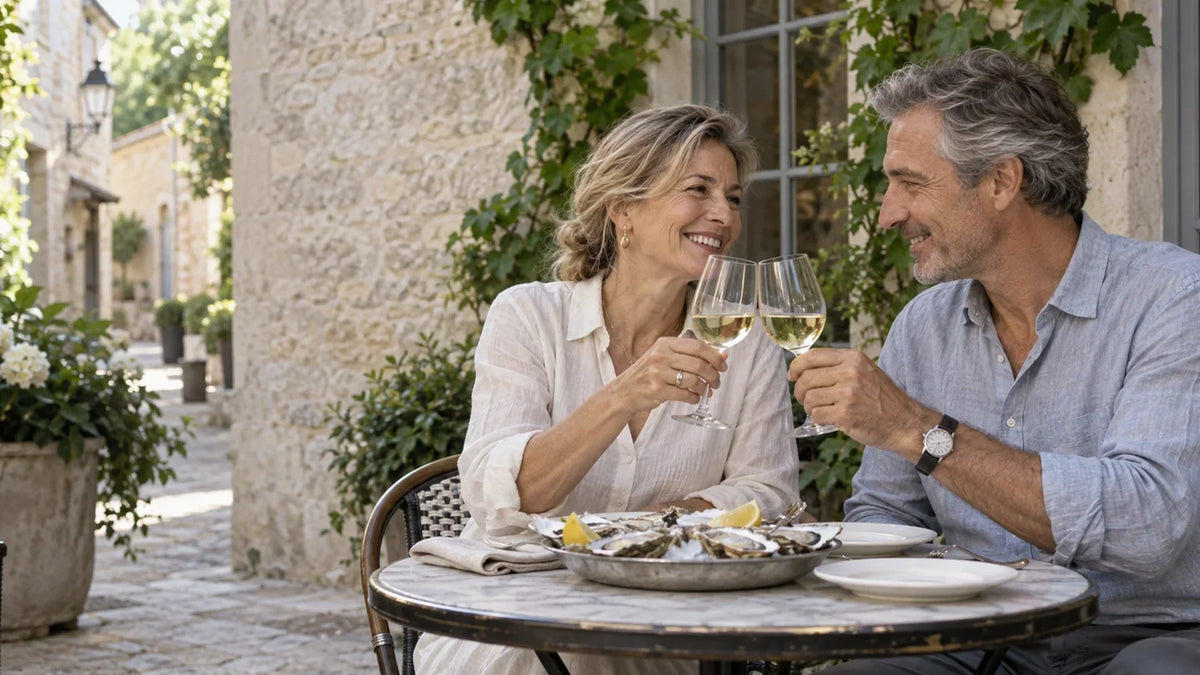
Decanting is rarely necessary, but a young, tightly wound bottle from a cold site will show more after fifteen minutes of air, and an older one can be poured off its light sediment. At the table, match weight to weight: lean styles want oysters, ceviche, goat cheese or a simple roast fish, and richer styles want butter and fat, which means lobster, crab, roast chicken or a creamy pasta. Mushrooms work with either.
What Makes One Chardonnay Taste Different From Another
Three decisions do nearly all of the work, and knowing them turns a wall of labels into a map. The first is the site. Cold places with fog or altitude, the Sonoma coast, the Sta. Rita Hills, the high vineyards of Mendoza, hold acidity and give citrus and stone. Warmer places give orchard and tropical fruit and a rounder body. The second is the barrel: new oak adds vanilla, toast and spice, while older barrels, concrete and steel add texture without flavor. The third is malolactic conversion, which turns sharp malic acid into softer lactic acid and creates the buttery note that people either seek out or run from. Producers make all three choices deliberately, and the best of them tell you so.
A word on where these come from. Most are Californian, with Italy, Argentina and a white Burgundy alongside them, because those are the bottles we can put in front of you today at this quality and this depth. White Burgundy is Chardonnay under a place name rather than a grape name, and the great names of Chablis, Meursault and Puligny-Montrachet move through in quantities too small to hold a slot here for long. If that is the direction you want, the Burgundy collection and our white Burgundy film are the right doors. And if you want the red counterpart to this page, our guide to the best Pinot Noirs to buy right now is built exactly the same way: rated, in stock, refreshed as bottles sell through. Everything we ship from the state sits in our California range.
Chardonnay questions, answered
What is the best Chardonnay to buy right now?
Our current top pick is 2023 Pahlmeyer Napa Valley Chardonnay at $98.98 — the highest-conviction wine on this list of twelve. If you want the whole spread, the complete 12-bottle case is $706.66 and ships free.
What is the best Chardonnay under $50?
Right now we recommend 2024 Lloyd by Robert Lloyd Carneros Chardonnay ($39.89); 2022 Bodega Aleanna 'El Enemigo' Chardonnay Mendoza ($34.99); 2022 Les Heritiers Saint-Genys Bourgogne Blanc Burgundy ($46.99); 2024 The Hilt Estate Chardonnay Sta Rita Hills ($49.99). Every wine on this page is in stock and scored 90+ — the list refreshes automatically as vintages sell through.
How much does a good Chardonnay cost?
More than it should, usually — but it does not have to. The twelve wines on this list run $30 to $99. Genuine, critic-scored Chardonnay starts around $30 when you buy from a direct importer instead of a restaurant list or grocery shelf.
What is the difference between oaked and unoaked Chardonnay?
Oak is a choice, not a grape trait. Ferment or age Chardonnay in new barrels and you pick up vanilla, baking spice, toast and a creamy weight; use older barrels, concrete or steel and you get citrus, orchard fruit and a leaner, more mineral line. Malolactic conversion is the other lever, turning sharp malic acid into softer lactic acid and adding that buttery note people either love or avoid. Most serious producers use a little of both and tell you so on the back label.
Why do so many people say they do not like Chardonnay?
They usually mean one style. In the 1990s a wave of cheap, heavily oaked, fully malolactic Chardonnay taught a generation that the grape tasted like butter and vanilla, and the backlash stuck. The grape itself is close to neutral, which is precisely why it reflects its site and its cellar so clearly. If a butter bomb put you off, a cool-coast or high-altitude bottling raised in older wood is a different wine entirely.
Is Chablis the same grape as Chardonnay?
Yes. Chablis is one hundred percent Chardonnay, grown on the fossil-rich Kimmeridgian limestone at the cold northern edge of Burgundy, and it is usually raised with little or no new oak. That is why it tastes so different from a warm-climate Chardonnay: same grape, colder site, lighter hand. White Burgundy in general, from Chablis down through Meursault and Puligny-Montrachet, is Chardonnay under a place name rather than a grape name.
What food goes with Chardonnay?
Match the weight. A lean, mineral style wants oysters, ceviche, goat cheese or a simple roast fish. A richer, oak-framed style wants butter and fat: lobster, crab, roast chicken, a creamy pasta, corn in late summer. Chardonnay is also the classic answer to anything involving mushrooms, and the one white that holds its own next to a proper cheese board.
How long can you age Chardonnay?
Most bottles are made to drink within three or four years, and there is nothing wrong with that. Serious examples from cool sites with real acidity can go a decade or more, trading fresh citrus for honey, hazelnut and a waxy texture. Acidity is the thing to look for: a wine that tastes taut and mouthwatering young will still be interesting later, while a soft, low-acid one is best opened while its fruit is fresh.
Related
 ▶WatchWhite Burgundy 6pk Sampler: The OG Chardonnay. Experience the Type of Chardonnay Everyone Tries to Be, But Few Can.
 ReadSonoma Wine: Where California Wine Was Born
 ReadArt, Land, and Wine: What a Visit to Donum Estate Actually Feels Like









These wines are waiting for you – shop now!
SHOP COLLECTIONShare:
The 12 Best Pinot Noirs to Buy Right Now, From Everyday Bottles to the Splurge
The 12 Best Wines for Thanksgiving, From the Welcome Pour to the Pie
Comments Section